
Table of Contents
- The Real Cost of Slow Transformation
- Traditional Consulting: The 18-Month Problem
- Rapid Business Improvement: The 100-Day Solution
- ROI Comparison: Speed vs. Depth
- When Traditional Consulting Makes Sense
- When Rapid Improvement Wins
- Making the Right Choice for Your Business
Your business is stuck. Revenue has plateaued. Team productivity isn’t where it needs to be. You know change is necessary, but which path delivers results faster: traditional consulting or rapid business improvement?
The answer depends on your timeline, budget, and tolerance for extended uncertainty. Traditional consulting offers comprehensive analysis but often takes 12-18 months to show measurable results. Rapid improvement models compress this timeline to 100 days while maintaining diagnostic depth.
This comparison examines both approaches through the lens of ROI, implementation speed, and sustainable outcomes to help you choose the right transformation partner.
The Real Cost of Slow Transformation
Every month your business operates below its potential costs money. While you evaluate options and wait for results, competitors gain ground.
Consider the math: A $20M business operating at 80% efficiency loses $4M in potential revenue annually. Traditional consulting might identify this gap in month 3, recommend solutions in month 8, and see implementation by month 15. That’s over $5M in lost opportunity during the engagement period.
Speed matters because market conditions change. Customer expectations shift. Technology advances. The longer transformation takes, the more your original diagnosis becomes outdated.
Traditional Consulting: The 18-Month Problem
Traditional consulting follows a predictable pattern: extensive discovery, detailed analysis, comprehensive recommendations, and client-led implementation.
Timeline Breakdown:
- Months 1-3: Discovery and stakeholder interviews
- Months 4-8: Analysis and strategy development
- Months 9-12: Report creation and presentation
- Months 13-18: Implementation support (if contracted)
Typical Deliverables:
- 200+ page strategic reports
- Process maps and organizational charts
- Technology recommendations
- Change management frameworks
The Implementation Gap: Here’s where traditional consulting often fails. After months of analysis, you receive recommendations but limited execution support. Your team, already stretched thin by daily operations, must implement complex changes while maintaining business performance.
Cost Structure: Traditional engagements typically cost $150K-$500K for mid-market businesses, with additional implementation fees. The total investment often reaches $750K-$1M when including internal resource allocation.
Rapid Business Improvement: The 100-Day Solution
Rapid improvement models compress the transformation timeline without sacrificing diagnostic quality. The focus shifts from exhaustive analysis to targeted execution.
100-Day Structure:
- Weeks 1-4: Comprehensive diagnostic across 80+ touchpoints
- Weeks 5-12: Rapid improvement execution on 2-3 high-impact constraints
Diagnostic Depth: Despite the compressed timeline, rapid improvement maintains analytical rigor. An 80+ touchpoint diagnostic covers:
- Vision and strategy alignment
- Organizational structure and talent gaps
- Process bottlenecks and inefficiencies
- Technology integration issues
- Financial performance drivers
Execution Focus: Rather than creating comprehensive reports, rapid improvement identifies the 2-3 constraints with the highest impact on performance. All effort concentrates on removing these specific bottlenecks.
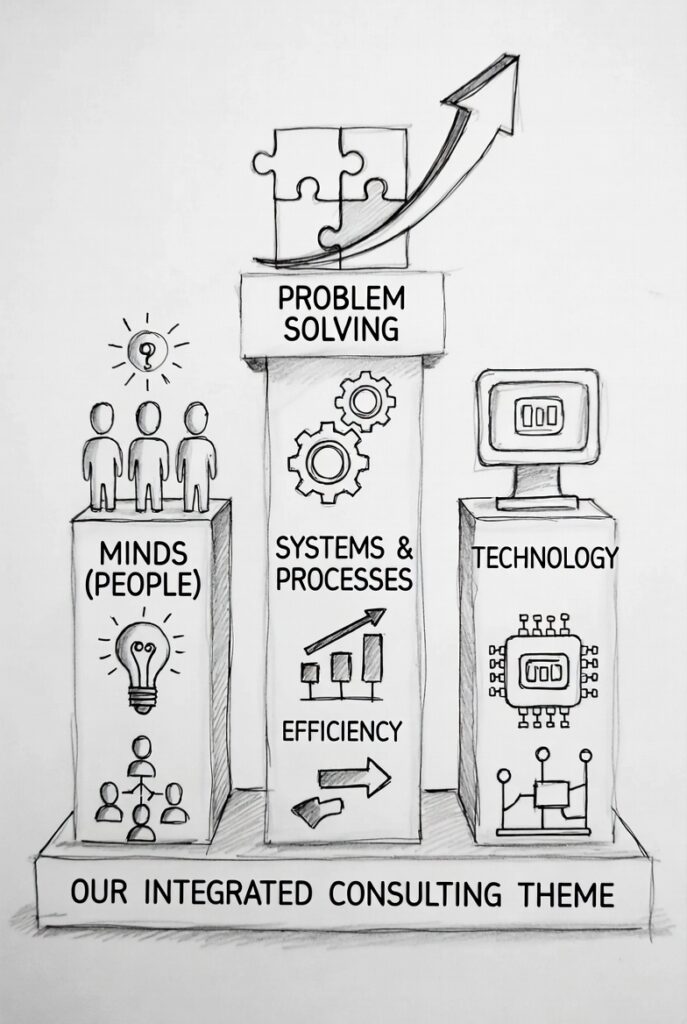
Integration Approach: The most effective rapid improvement models integrate three critical areas: Minds (talent and structure), Systems (processes and accountability), and Technology (CRM, ERP, analytics). This prevents the siloed improvements that characterize traditional consulting.
ROI Comparison: Speed vs. Depth
Traditional Consulting ROI:
- Investment: $750K-$1M total cost
- Timeline: 18 months to see results
- Implementation risk: High (client-dependent)
- Opportunity cost: 18 months of suboptimal performance
Rapid Improvement ROI:
- Investment: $200K-$400K total cost
- Timeline: 100 days to see results
- Implementation risk: Low (consultant-led execution)
- Opportunity cost: 3.3 months of suboptimal performance
The Math: For a $20M business with 20% improvement potential:
- Traditional: $4M potential gain over 18 months = $2.2M annual ROI
- Rapid: $4M potential gain over 100 days = $14.6M annualized ROI
The rapid approach delivers 6x faster ROI realization, even with similar improvement outcomes.
When Traditional Consulting Makes Sense
Traditional consulting remains valuable for specific scenarios:
Complex Regulatory Environments: Heavily regulated industries requiring extensive compliance documentation benefit from traditional consulting’s thoroughness.
Large-Scale Digital Transformation: Enterprise-wide technology implementations spanning multiple years need traditional consulting’s comprehensive planning approach.
Merger Integration: Combining two organizations requires the detailed cultural and process analysis that traditional consulting provides.
Board-Level Strategic Pivots: When boards require extensive documentation and analysis for major strategic shifts, traditional consulting delivers the depth needed for stakeholder confidence.
When Rapid Improvement Wins
Rapid improvement excels in common mid-market scenarios:
Performance Plateaus: When revenue or profitability has stagnated despite market opportunities, rapid improvement quickly identifies and removes constraints.
Failed Previous Initiatives: If past consulting engagements produced reports but no results, rapid improvement’s execution focus addresses the implementation gap.
Leadership Bandwidth Constraints: CEOs without capacity to lead lengthy transformation projects benefit from consultant-driven rapid execution.
Competitive Pressure: When competitors are gaining ground, the speed of rapid improvement prevents further market share erosion.
Pre-Exit Optimization: Businesses preparing for sale need quick performance improvements to maximize valuation.
Making the Right Choice for Your Business
Your decision should align with three factors: urgency, complexity, and implementation capacity.
Choose Traditional Consulting If:
- Your transformation involves regulatory compliance
- You need board-level documentation
- Timeline pressure is minimal
- Internal change management resources are strong
Choose Rapid Improvement If:
- Revenue or profit pressure is immediate
- Previous consulting efforts stalled in implementation
- Leadership bandwidth is constrained
- Market conditions demand quick response
Questions to Ask Potential Partners:
- What specific constraints will you address in the first 100 days?
- How do you ensure implementation happens during the engagement?
- What measurable outcomes can I expect by day 100?
- How do you integrate strategy, operations, and people changes?
The choice between traditional consulting and rapid business improvement isn’t about better or worse—it’s about fit. Your business situation, timeline pressures, and implementation capacity determine which approach delivers superior ROI.
For mid-market businesses facing performance plateaus with limited leadership bandwidth, rapid improvement models offer a compelling alternative to traditional consulting’s lengthy timelines and implementation gaps.
Learn more about rapid business transformation at 100dayrenew.com.
Frequently Asked Questions
What’s the main difference between traditional consulting and rapid business improvement? Traditional consulting emphasizes comprehensive analysis over 12-18 months with client-led implementation. Rapid business improvement compresses diagnostics to 4 weeks and focuses on consultant-led execution of 2-3 high-impact improvements within 100 days.
How can rapid improvement maintain quality with such a compressed timeline? Rapid improvement uses focused diagnostics targeting 80+ specific touchpoints rather than exhaustive analysis. By concentrating on the highest-impact constraints, it maintains diagnostic quality while accelerating results.
What size business benefits most from rapid improvement? Mid-market businesses with $5M-$100M revenue and 50-500 employees see the greatest benefit. These organizations have enough complexity to need structured improvement but lack the resources for lengthy traditional consulting engagements.
Can rapid improvement handle complex organizational issues? Yes, but with a different approach. Rather than addressing every issue simultaneously, rapid improvement identifies the 2-3 constraints with the highest impact and focuses all effort on removing these specific bottlenecks first.
How do you measure ROI in just 100 days? ROI measurement focuses on the specific constraints addressed during the engagement. Metrics might include revenue per employee, customer acquisition cost, or operational efficiency ratios, depending on the targeted improvements.
What happens after the 100-day engagement ends? Effective rapid improvement creates sustainable playbooks and processes that continue delivering results. Many providers offer quarterly reviews to ensure continued progress and address new constraints as they emerge.
Is rapid improvement suitable for businesses that have tried consulting before? Absolutely. Rapid improvement specifically addresses the implementation gap that causes many traditional consulting engagements to fail. The focus on execution rather than analysis makes it ideal for businesses frustrated with previous consulting experiences.