
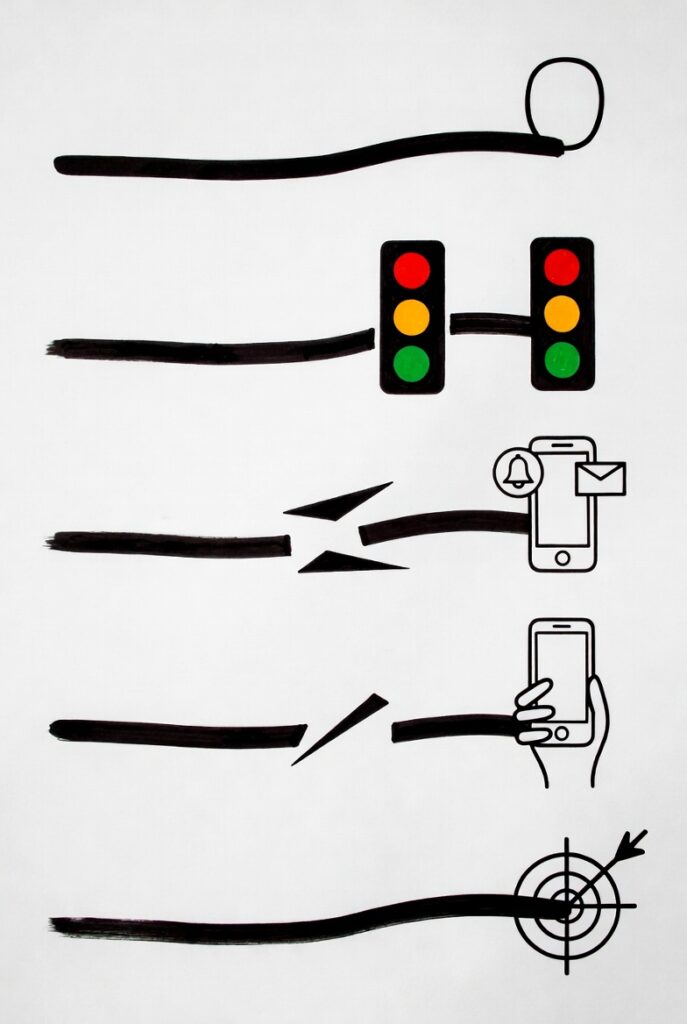
Most CEOs I work with believe their biggest enemy is a lack of time. After spending nearly 5 decades across boardrooms in India, the Gulf, and Africa, I have come to a different conclusion. The real constraint is not the hours in the day. It is what happens to our span of attention in the few seconds between one interruption and the next, and whether we use that sliver well or simply let it slide past us.
The Walk That Made Me Notice This
This week, several conversations happened on foot, on the way to and from the Bahnhof between meetings. We were forced to stop more than once at a traffic light, waiting for red to change to green. That pause is what brought the pattern into focus. The traffic light itself was not the disruption. The disruption was the brief, charged moment right after the change, when the mind was supposed to register something and act on it, often without quite managing to.
I noticed the same pattern everywhere else in the week. A notification on the smartwatch pulled attention away from a conversation mid-sentence. An OTP prompt demanded a glance at the phone during a client call. An unsolicited sales call broke a chain of thought that had taken twenty minutes to build. None of these events demand much from us individually. Collectively, they have redefined what our attention actually looks like during a normal working day.
I want to be precise about who this observation applies to. I am not describing the general pull of screens that affects almost everyone now. I am describing people who are otherwise disciplined and mindful, who would describe themselves as in control of their day. Even for this group, the span of attention has narrowed to these short alert windows, whether anyone designed it that way or not.
The Decision Sliver Is Now the Unit of Work
Classical productivity advice assumes long, uninterrupted blocks of deep work. That assumption no longer matches how a CEO’s day unfolds. The actual unit of cognitive work has shrunk to what I call the decision sliver: the few seconds between an interruption ending and the next one beginning. A traffic light changing from red to green. One notification giving way to another. The gap after an OTP is entered and before the next message arrives.
These slivers are not the enemy of good decision-making. They are where most of it now actually happens. The CEOs who manage this well are not the ones who have eliminated interruptions, because that fight cannot be won in any modern business. They are the ones who have trained themselves to use the sliver itself, rather than spend it recovering from the last disruption or bracing for the next one.
This is not just a matter of feeling scattered. Gloria Mark’s research at the University of California, Irvine, found that knowledge workers take an average of around twenty-three minutes to fully regain focus on a task after being interrupted. If a CEO is interrupted even three or four times in a working day, by genuine necessity rather than choice, the arithmetic alone explains why so little deep thinking survives intact by evening. The decision sliver matters precisely because the recovery cost of ignoring it is this high.
Three Ways the Sliver Gets Wasted
In my diagnostic conversations with founders, I see three recurring patterns that drain the decision sliver before it can be used:
- Recovery lag — the first two or three seconds after an interruption are spent re-establishing where the mind was, rather than acting on what matters now
- Anticipatory bracing — attention is spent watching for the next interruption instead of using the current window
- Default reaction — the sliver gets filled automatically with whatever triggered it, such as replying to the notification, rather than redirected toward the task that was interrupted
Each of these is a leadership habit, not a technology problem. No amount of digital hygiene will fix a mind that has not been trained to occupy its own decision slivers with intention.
The real span of attention is not the long meeting or the quiet morning. It is the three seconds after red turns to green, and whether you are reacting in that moment or ready for it.
If you suspect your own decision-making has quietly migrated into these short windows without your noticing, that is usually the first sign worth examining before anything else. Start with a free consultation and we can look at where your attention is actually being spent during a working day.
Building a Personal Governance for the Sliver
Treating the decision sliver as a unit worth managing changes how a leader prepares for the day. Three practices have worked consistently with the founders and CXOs I coach.
First, name the sliver before it arrives. Most interruptions in a CEO’s day are predictable: the daily traffic light on a regular walk, the recurring notification, the OTP that comes with every approval. Knowing where these moments will land allows you to decide in advance what you will do with the gap that follows, rather than improvising in the moment.
Second, anchor one decision per sliver, not a list. The temptation is to use a short window to mentally run through everything pending. That produces only anxiety. A single, specific decision anchored to that moment is far more likely to be acted on than a vague intention to “think about it later.”
Third, audit a week of your own slivers honestly. Most leaders are surprised by how many of these short windows in their day are spent in recovery or reaction rather than in deliberate use. This audit alone, done without judgement, usually reveals more about where focus is leaking than any time-management exercise.
The Real Test Is in the Three Seconds
Every CEO believes they would perform well given a clear, uninterrupted hour to think. Fewer have tested whether they perform well in the three seconds after a disruption ends. That second test, not the first, increasingly determines the quality of decisions made across a working week.
If your own span of attention has quietly narrowed into these short windows, the fix does not start with eliminating interruptions. It starts with deciding, in advance, what you intend to do the moment red turns to green.
Book your free Business Diagnostic with Coach Sam today.