
The Assumption Running Through Most Business Problem Solving
Business problem solving carries a comfortable assumption at its centre — that business problems are fundamentally logical puzzles, and that rigour, structured analysis, and fresh perspective will resolve them. Most organisations operate on this belief. Most problem-solving engagements are designed on its basis, and most problem-solving frameworks reinforce it.
The assumption is wrong often enough to be expensive.
Not wrong because logic is useless — it is not. Wrong because logic addresses only the visible layer of the problem, while everything that keeps the problem alive tends to sit underneath that layer, and most approaches to business problem solving never reach it. After four decades working across industries and governance structures, the pattern is consistent: the problems that stay nagging — that outlast consultants, internal task forces, and strategy cycles — are not the ones that resisted analysis. They are the ones that were never correctly defined, or were protected by interests that no analysis could remove, or sat inside an organisational dynamic that made the correct answer inadvisable to state.
That is the real terrain of business problem solving. Understanding it requires skills that go well beyond method.
The First and Most Stubborn Barrier: Problem Definition
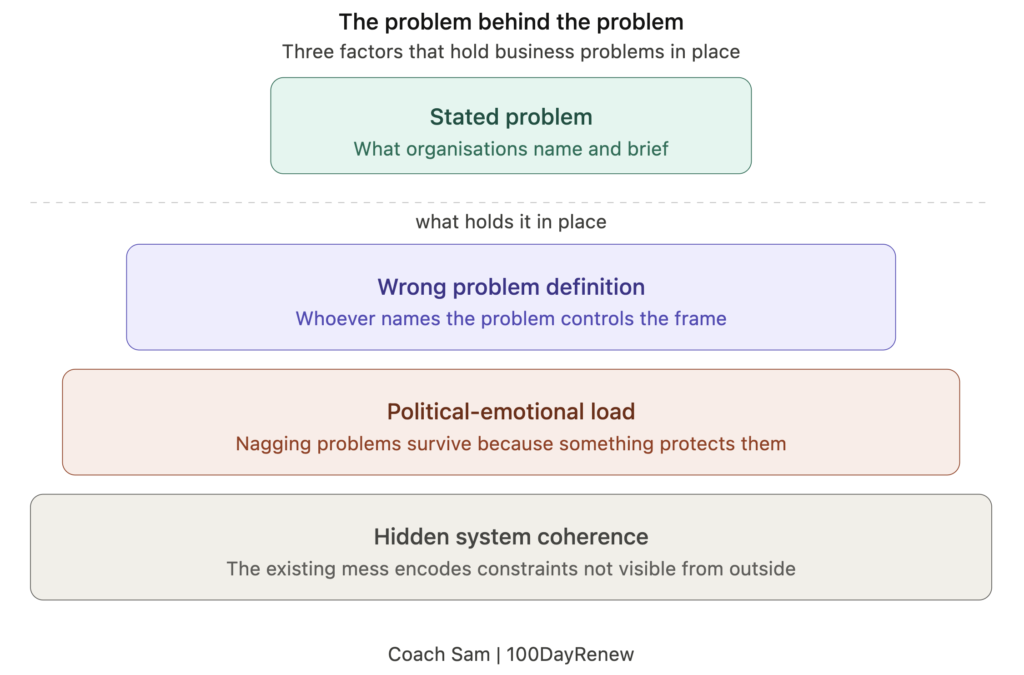
The most stubborn factor in business problem solving is not missing data or organisational complexity. It is the framing. Problems do not arrive neutral. They arrive pre-shaped by whoever has the authority to name them — by the executive whose division owns the issue, by the brief that scoped the work, by the accumulated history of previous attempts that narrowed what counts as a legitimate answer.
That framing smuggles in assumptions about what is in scope, who is implicated, and what kind of solution is permissible. Most problem-solving work accepts that framing and begins operating inside it, which means the first and most consequential decision in the engagement has already been made — by someone else, before the work started. The result is frequently a technically rigorous answer to a question that was not the right question.
In practice, I have worked on manufacturing quality failures that turned out to be procurement decisions protected by a CFO’s prior judgment. I have worked on market share problems that were, at their root, leadership configuration problems that nobody in the room had authority to name. In both situations, solving inside the original frame would have produced a well-presented result that changed nothing.
Interrogating the framing is therefore not an optional early step — it is the first step. The question worth asking is: who named this problem, and what would change for them if the real cause turned out to lie somewhere else entirely? Where in diagnostic conversations do people become vague, defensive, or suddenly discover a more comfortable topic? That terrain is more revealing than anything stated directly.
Why Nagging Business Problems Stay That Way
A nagging problem has survived previous attempts to solve it. That survival is data, not misfortune, and experienced problem solvers treat it as such. It almost always means the obvious moves are blocked by something the organisation will not name.
The blocking mechanism is usually a conflict between what the problem requires and what some influential part of the organisation can accept. The cost line that cannot be touched because it reflects the founder’s original vision. The structural inefficiency that cannot be removed because it is the price of a political settlement between two leaders. The senior executive whose performance is the actual problem but whose departure the organisation considers too destabilising to contemplate. We call these problems nagging because they keep reappearing on agendas. They keep reappearing because we keep solving around them rather than through them.
This dynamic accumulates weight over time. Every failed attempt adds a layer — the scar tissue of recommendations that were never implemented, the exhaustion of internal champions who stopped raising the issue, the quiet resignation of the middle tier who concluded that nothing would change. By the time a problem becomes genuinely nagging, it is carrying all of that history alongside the original diagnostic challenge.
The technical solution to most nagging business problems exists, or is findable. What usually does not exist is organisational permission to implement it. Understanding who holds that permission, what it would cost them to grant it, and whether conditions exist for that to change is often more valuable work than any quantitative analysis.
The Hidden Logic Inside Organisational Dysfunction
There is a version of problem solving that treats the existing state of affairs as simply broken — irrational, inefficient, and waiting to be replaced with something better. This version is seductive, and it has a mediocre track record.
Most organisational dysfunction encodes constraints that are not visible from the outside. The process that looks absurdly bureaucratic was often designed after a compliance failure that nobody advertises. The structural duplication that appears wasteful tends to reflect a political settlement whose reopening would cost more than the duplication saves. Chesterton’s fence operates in business as reliably as anywhere else: before removing what looks like an obstacle, understand why it was built. Problem solvers who skip this step have historically produced a second, often larger, set of problems while confidently eliminating the first one.
The right posture here is to approach the existing system as a witness rather than a judge. Why does this structure exist? What did it solve? Where has it created genuine value, even alongside its failures? The answers often reveal load-bearing constraints that any viable solution must respect — constraints that purely analytical approaches systematically overlook.
Where Business Problem Solving Should Actually Begin
Given what actually holds business problems in place, the question of where to start deserves more serious treatment than most approaches provide. Gathering data, interviewing stakeholders, and forming hypotheses is not wrong as a sequence, but it is dangerously thin if taken as a complete method.
A more productive entry point is deliberate scepticism toward everything stated clearly, and genuine curiosity toward everything that appears to be avoided.
The first practical move is to study anomalies rather than averages. Where is something working that on paper should not — the team hitting targets despite a broken process, the product retaining customers against the market trend? Where is something failing that every available model says should succeed? Anomalies expose causal structure faster than headline metrics because they reveal exactly where the stated explanations break down, which is consistently where the real problem lives.
The second move is to trace actuals against stated priorities. Where does cash actually flow, compared to stated investment priorities? Where does senior leadership time actually concentrate, compared to the organisation’s stated focus? Where does customer attention and spending actually go, relative to the assumptions built into the business model? The gap between revealed and stated priorities is one of the most reliable diagnostic signals in organisational problem solving, and it is almost always visible to anyone willing to look at it honestly.
The third is to hold everything communicated as a hypothesis rather than a fact. Everyone inside a system carries a partial view, shaped by their role, their history, and their interests. The picture a problem solver needs requires triangulating across many of those partial views, and that triangulation rarely confirms the original brief.
The Question That Reframes the Entire Diagnostic
Before any solution design begins, one question should be asked and answered with discipline: why is this problem still here?
The answers group into three categories, each of which requires entirely different work. The first is misdiagnosis — the organisation has been solving the wrong problem, thoroughly and expensively, while the real one goes untouched. The remedy is reframing, and that requires someone’s prior analysis to be set aside, which is politically harder than it sounds and should be managed as a separate piece of work in its own right.
The second is a protected trade-off. The organisation understands, at some level, what the problem is and what solving it would require. But the required move conflicts with an interest, a relationship, or a belief that the organisation values more than the solution. The work here is less analytical than organisational — helping decision-makers confront the trade-off consciously rather than continue avoiding it indefinitely.
The third is a capability or will deficit. The organisation knows what to do, has no fundamental objection to doing it, and simply cannot execute — because the skills are absent, the capacity is consumed elsewhere, or the leadership energy has run dry. This is the most tractable category of the three, and the one most frequently misidentified as one of the other two.
Diagnosing which category applies, before any solution is proposed, is the real first deliverable of serious business problem solving. It is also the step most consistently skipped in the pressure to move toward recommendations.
https://100dayrenew.com/why-your-business-stopped-growing-and-how-to-fix-it-in-100-days/
The Capabilities the Work Actually Requires
Organisational problem solving at the level that produces real change requires a specific set of capabilities that most frameworks underweight.
Diagnostic patience — the ability to resist premature solution, to stay inside the question longer than is comfortable, and to let the picture form before committing to a hypothesis. Most engagements apply pressure in exactly the opposite direction, and resisting that pressure is a discipline that has to be actively maintained.
Political literacy, understood not cynically but structurally. Reading who carries influence and why, what the real costs of different moves are for different actors, where the actual permission for change sits in the organisation — this is not about manipulation. It is about working with reality rather than against it.
Tolerance for ambiguity. Most nagging business problems are messy at the edges. Data is incomplete, stakeholders contradict each other, and history is contested. The ability to work productively inside that ambiguity, without forcing premature clarity, separates effective problem solvers from technically competent but ultimately ineffective ones.
The willingness to name what others avoid is perhaps the most important capability of all. The most valuable diagnostic observation in a problem-solving engagement is almost always the thing nobody in the room has been willing to say. Getting it into the room, in a form that can be worked with rather than immediately rejected, requires timing, clarity, and relational credibility — none of which any methodology teaches. These come from experience and from a genuine commitment to the client’s outcome over the comfort of the engagement.
A More Useful Frame for Nagging Business Problems
Organisations that actually resolve nagging business problems tend to share one characteristic: somewhere in the process, someone stopped trying to solve the problem and started trying to understand why it was still there.
That shift is not semantic. It changes the questions asked, the data collected, the people brought into the room, and ultimately what gets recommended and acted upon.
The hard part of business problem solving has never been the analytics. Analytical tools are widely available and broadly understood. The hard part is earning permission — from the organisation, and sometimes from the client — to look in the right place. That permission rarely sits in the original brief. It has to be earned by demonstrating something rarer than technical competence: the willingness to slow down when the pressure is to go fast, to ask an uncomfortable question when a comfortable answer is available, and to stay honest when honesty is inconvenient.
That is what separates strategic problem solving as a genuine discipline from problem solving as a performance. Most organisations, if pressed, recognise the difference. Most have experienced considerably more of the latter than they would like to admit.