
“How do we fix our Culture?” Founders and Boards ask me this more often than any other question, and it usually surfaces after something has already broken. Attrition climbs in a critical function, a customer escalation reveals that nobody owned the problem, or a strategy everyone endorsed simply refuses to move. Organisational culture change then gets commissioned as a project, complete with a townhall, a refreshed values statement and a leadership offsite. Unfortunately, that approach carries a poor record, and the evidence against it is blunt rather than ambiguous.
Organizational Culture Change – Communication campaigns do not work
Donald Sull and his colleagues at MIT Sloan collected the published values of more than 500 large organisations. They then compared those statements against how employees described the same organisations across more than 1.2 million Glassdoor reviews. They found no correlation between the values a company advertises and the Culture its people actually experience. Four of the nine values tested, among them collaboration, customer orientation and execution, correlated negatively. In other words, the firms that talk loudest about collaboration are, if anything, marginally less collaborative.
None of this should surprise anyone who has sat through a values launch. Communication tells people what the leadership wishes were true. However, it does nothing about what the business actually rewards on a Tuesday afternoon, when a shipment is late and two managers disagree about who decides. Simply put, people read the System, not the poster.
Culture is an output, not an input
Here is the reframe that changes the conversation in a board meeting. Culture is not something you install. In reality, it is what remains after the conditions you have built decide which behaviours survive, which get rewarded and which get quietly punished. When you change those conditions, you have changed the Culture. That is what organisational culture change actually means, whether or not you ran a campaign about it.
Regulators have moved in the same direction. The UK Corporate Governance Code, revised by the Financial Reporting Council in January 2024, now goes further. Boards must assess and monitor Culture, and also assess how the desired Culture has been embedded. That second clause is the harder one. Monitoring sentiment through an annual survey is comfortable, while evidencing embedment forces a Board to examine structure, incentives and decision rights. Companies in India, the GCC and Africa sit outside that Code, of course, yet investors and acquirers increasingly ask the same question during diligence.
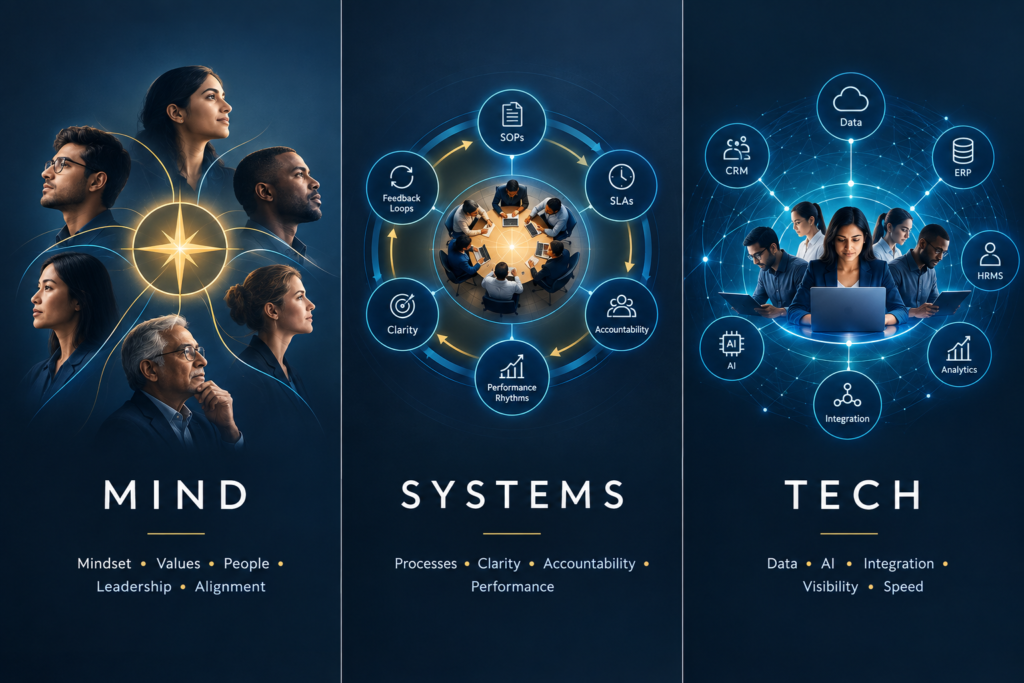
Three conditions do most of the work in organisational culture change. They are the three levers I use in every Business Diagnostic: Minds, Systems and Technology.
Minds: the right people, inside a structure that helps them
Minds concerns people, and the lever opens with three uncomfortable questions. Do you have the right people, with the right mindset, in the roles that genuinely matter? Does your team name capability gaps openly in review meetings, or does it defer them politely because the individual is loyal and long serving? Does your organisational structure support the strategic vision and the stated values, or does it quietly work against both?
Most Founders can answer the first question honestly in private. The second is where it usually breaks down. A capability gap that nobody will name becomes a performance standard, because every other manager now understands exactly what the business tolerates. Structure then compounds the damage. When two functions share an outcome and neither one owns it, you have not created collaboration. You have created a vacuum, and people fill vacuums with self-protection.
Systems: what actually pays, and who actually decides
Systems covers your SOPs, your KPIs, your accountability frameworks and your decision rights. Together these tell people what the business genuinely rewards, which is rarely identical to what the values poster claims. Most organisational culture change programmes never touch this layer at all. When decision rights stay unclear, people fill the gap with individual judgment, and you end up with as many micro-cultures as you have managers.
The evidence here is unusually direct. Graham, Grennan, Harvey and Rajgopal surveyed 1,348 North American executives for the Journal of Financial Economics. Ninety-two per cent believed that improving Culture would increase firm value, while only 16 per cent believed their own Culture was where it should be. More revealing still, those executives reported that hiring, firing and promotion policies reinforce their Culture only about half the time. Incentive compensation supports it in roughly half of cases. Simply put, the machinery deciding who rises and who gets paid is pulling against the stated Culture in half of all companies.
Decision rights carry a measurable cost as well. Bain & Company surveyed close to 800 companies, measuring revenue growth, return on capital and total shareholder return. Decision effectiveness and top-tier financial results correlated at 95 per cent. Therefore, a Culture conversation that never touches who decides what, and by when, remains an incomplete conversation.
Curious about which of these three levers is holding your business back? A short Business Diagnostic conversation usually locates it faster than another engagement survey.
Technology: friction decides whether good behaviour survives
Technology determines whether the behaviour you want is easy or exhausting to execute, and most organisational culture change programmes ignore it entirely. Your CRM, HRMS, ERP and analytics systems should improve visibility, reduce friction and support faster decisions. When they do the opposite, people route around them, and the workaround quietly becomes the real process.
The scale of that friction has grown. Gartner’s digital worker survey covered 4,861 full-time employees across the US, UK, India and China. Knowledge workers now use around 11 applications in a working day, against six in 2019. Five per cent use 26 or more. Ask a sales manager to log a single customer visit in three systems and you have not built accountability, you have handed everyone a ready-made excuse.
The three levers reinforce each other, or they cancel out
The three have to work together, because each one can neutralise the others. The right people struggle inside broken Systems, and in time they either leave or adapt downward. Good Systems lose their effectiveness when Technology creates friction at every handover. Strong Technology, meanwhile, simply accelerates a weak System, which is why so many digital programmes make a confused business faster at being confused.
The cost of ignoring this usually appears in the attrition line well before it appears in the P&L. Sull, Sull and Zweig analysed 1.4 million Glassdoor reviews across roughly 600 companies. A toxic Culture predicted industry-adjusted attrition 10.4 times more powerfully than compensation. Low pay ranked sixteenth on their list. In reality, your people are not leaving over salary nearly as often as your exit interviews suggest.
The Board owns Trust, and hidden agendas destroy it
One responsibility a Board cannot delegate to management is transparency. The Board, together with the leadership team, has to make Trust and Mutual Respect sacrosanct rather than aspirational. No organisational culture change survives without that foundation. Hidden agendas kill Trust. They sit in a promoter’s head, or in a side conversation about succession. Sometimes they sit around a quietly protected business unit that escapes the scrutiny everyone else faces. Once Trust has gone, every Culture initiative that follows becomes theatre, and your people recognise that long before the Board does.
The performance case is well documented. Paul Zak’s research, published in Harvard Business Review, compared high-trust and low-trust companies. People in the high-trust group report 50 per cent higher productivity, 76 per cent more engagement and 40 per cent less burnout. Zak is explicit that high-trust organisations hold people firmly accountable without micromanaging them. Trust is not softness, then. It is the condition that makes accountability bearable, and without it even a well-designed System reads as surveillance.
Where organisational culture change actually begins
If your last organisational culture change initiative faded within two Quarters, the explanation most likely sits in one of these three levers rather than in your communication plan. Look first at who holds the key roles and whether the structure helps or hinders them. Look next at what your KPIs, decision rights and promotion decisions actually reward. Look then at whether your Technology makes the right behaviour the easy behaviour. And look finally at whether the Board has made transparency a condition of employment at the top. That one is usually the hardest to say out loud.
Minds. Systems. Technology. That is where the Diagnostic begins, and it is a considerably better use of a leadership offsite than another conversation about values.
Book your free Business Diagnostic conversation at 100dayrenew.com/booking. Limited slots each month.
References
Tier 1, peer-reviewed academic research
- Graham, J.R., Grennan, J., Harvey, C.R. and Rajgopal, S. (2022). Corporate culture: Evidence from the field. Journal of Financial Economics, 146(2), 552 to 593. Survey of 1,348 North American executives.
Tier 2, practitioner research and management publications
- Sull, D. and Sull, C. (2020). When It Comes to Culture, Does Your Company Walk the Talk? MIT Sloan Management Review, 21 July 2020. Official values of 500-plus large firms against 1.2 million Glassdoor reviews.
- Sull, D., Sull, C. and Zweig, B. (2022). Toxic Culture Is Driving the Great Resignation. MIT Sloan Management Review, 11 January 2022. 1.4 million reviews, roughly 600 companies, April to September 2021.
- Zak, P.J. (2017). The Neuroscience of Trust. Harvard Business Review, January and February 2017 issue, pages 84 to 90.
- Blenko, M.W., Mankins, M.C. and Rogers, P. (2010). Score your organization to improve decision effectiveness. Bain & Company, drawing on Decide & Deliver (Harvard Business Review Press, 2010).
- Gartner Digital Worker Survey, conducted September to November 2022 among 4,861 full-time employees in the US, UK, India and China; figures as reported by Computerworld.
Tier 3, regulatory source
- Financial Reporting Council (2024). UK Corporate Governance Code, Provision 2, published 22 January 2024, effective for financial years beginning on or after 1 January 2025.
Tier 4, practitioner constructs
Business Diagnostic, Constraint and Full Potential are 100DayRenew constructs drawn from engagement experience.